

Why Two Similar Phoenix Businesses Can Have Completely Different Sale Values
Introduction: Similar Businesses Do Not Always Have Similar Values
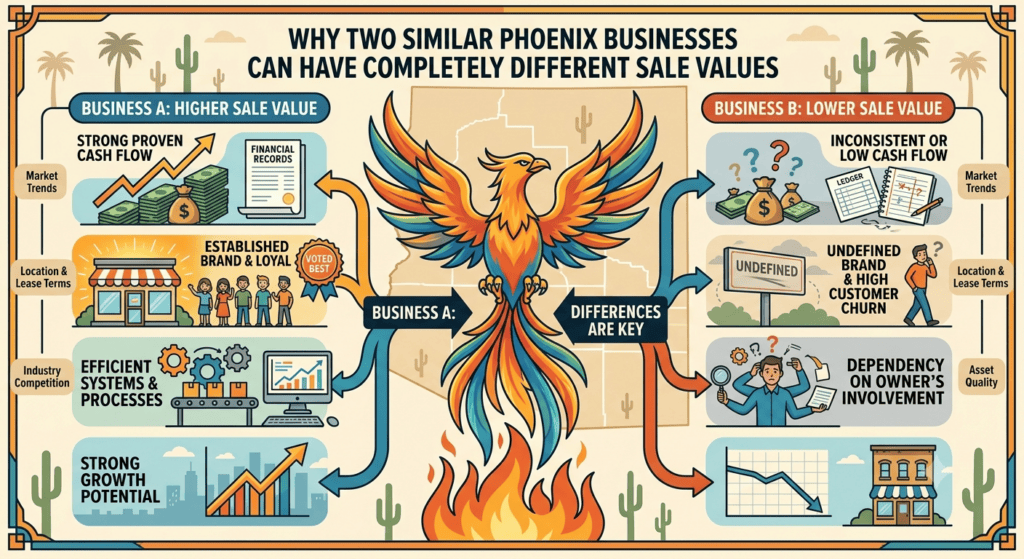
Two businesses can operate in the same Phoenix market, serve similar customers, generate comparable revenue, and still command very different sale prices. At first glance, their financial statements may appear almost identical, making the difference in valuation difficult for owners to understand. However, business value depends on far more than annual revenue or even reported profit. Buyers examine the quality, predictability, sustainability, and transferability of the earnings they are acquiring. They also consider the risks that could affect future cash flow after ownership changes hands. This is why understanding the underlying drivers of value is essential for any Phoenix business owner considering a future sale.
Revenue Is Only One Part of the Valuation
Revenue is often the first number business owners compare when discussing a potential sale, but it does not tell the complete story. Two Phoenix businesses may each generate $2 million in annual sales while producing very different levels of profit. One company may have strong margins, efficient operations, recurring customers, and controlled expenses, while the other may rely on heavy discounting and expensive customer acquisition. Buyers generally focus on the earnings and cash flow that can reasonably continue after the transaction. A higher revenue figure does not automatically compensate for weak margins or inconsistent profitability. When we evaluate a business, we look beyond the top line to understand what the revenue actually contributes to the company’s long term financial performance.
The Quality of Earnings Can Change Everything
The quality of earnings is one of the most important considerations when determining what a buyer may be willing to pay. Predictable earnings supported by recurring revenue and stable customer relationships can provide greater confidence than profits generated through irregular transactions. A business that produces consistent cash flow year after year may therefore attract stronger buyer interest than a company with higher but unpredictable earnings. Buyers want to understand whether historical performance represents a sustainable operating model or an unusually strong period that may not continue. They also examine expenses, owner compensation, unusual costs, and other financial adjustments that can affect normalized earnings. Strong financial documentation allows us to present the underlying economic performance of a business more clearly during the valuation and sale process.
Customer Concentration Creates Hidden Risk
Customer concentration can significantly influence how a buyer views an otherwise successful Phoenix business. A company that receives a large percentage of its revenue from one customer may face substantial risk if that relationship ends after the acquisition. Another business with the same revenue level but a diversified customer base may provide greater stability because its income is distributed across many accounts. Buyers often examine customer retention, contract terms, renewal patterns, and the history of major accounts before determining how much risk is involved. A concentrated customer base does not necessarily make a business unsellable, but it can affect negotiations and the level of confidence buyers have in future revenue. Reducing unnecessary customer concentration and strengthening relationships across the broader client base can therefore improve the overall attractiveness of a company.
Owner Dependence Can Reduce Transferability
A business can be profitable while still being heavily dependent on its owner, and that dependency can influence its market value. If the owner personally manages most customer relationships, sales activities, vendor negotiations, hiring decisions, and daily operations, a buyer may question how easily the company can operate without that individual. Businesses with established management systems, documented procedures, trained employees, and repeatable processes are often easier to transition to new ownership. Buyers are purchasing an operating business rather than simply purchasing the owner’s personal workload. The less dependent the company is on one individual, the easier it can be for a buyer to visualize continued performance after closing. We help owners identify these dependencies because operational independence can become an important part of preparing a company for market.
Recurring Revenue Can Strengthen Buyer Confidence
The structure of revenue can be just as important as the amount of revenue a business generates. Contractual relationships, memberships, subscriptions, maintenance agreements, repeat purchasing patterns, and other recurring revenue models can provide greater visibility into future performance. By comparison, a company that must constantly find new customers to replace completed one time transactions may present a different level of risk to prospective buyers. Buyers generally want evidence that future cash flow has a reasonable foundation rather than depending entirely on historical sales. Strong retention rates and predictable customer behavior can make financial projections easier to understand and defend. When we assess business value, recurring revenue is therefore considered alongside profitability, customer quality, growth trends, and the broader risk profile.
Growth Trends Matter More Than a Single Strong Year
A business that has grown consistently over several years can tell a very different story from one that experienced a temporary spike in revenue. Buyers often examine historical financial statements to determine whether growth is supported by durable market demand, improved operations, stronger customer retention, or unusual circumstances. Consistent growth can demonstrate that the company has developed an operating model capable of producing additional revenue without creating disproportionate costs. Conversely, declining margins or slowing sales can raise questions even when the current revenue figure remains impressive. The timing and sustainability of growth can therefore affect how buyers interpret the company’s future potential. Preparing a clear history of financial and operational performance helps us distinguish sustainable growth from short term fluctuations.
Reputation and Brand Strength Have Financial Importance
A company’s reputation can influence buyer perception even though it may not appear as a separate line item on an income statement. Strong online reviews, customer loyalty, recognizable positioning, positive referrals, and established relationships can create intangible value that supports future sales. A business with a trusted reputation may require less effort to maintain customer acquisition and retention than a company with similar financial results but a weaker market presence. Buyers may also examine complaints, litigation history, online sentiment, and other reputation related factors before completing their evaluation. A strong brand does not eliminate financial or operational risks, but it can contribute to the overall attractiveness of a business. We consider these qualitative factors because a company’s market reputation can influence both buyer interest and the confidence behind an eventual transaction.
Location and Market Conditions Also Influence Value
Phoenix is a large and diverse business market, which means local economic conditions can affect the attractiveness of different companies. Two businesses located only a few miles apart may serve different customer demographics, industries, neighborhoods, or competitive environments. Buyers may evaluate population trends, commercial development, competition, labor availability, local demand, and industry conditions when considering an acquisition. A business positioned in a growing market with strong demand may attract different interest from one operating in a highly competitive or slower changing segment. The physical location of a business can also matter when the company depends on local customers, facilities, employees, or specialized infrastructure. Understanding how the business fits into its specific Phoenix market provides important context when interpreting financial performance and potential buyer demand.
Systems and Documentation Can Increase Buyer Confidence
Strong businesses often have processes that allow employees to perform important responsibilities without constant owner involvement. Documented procedures for sales, customer service, accounting, purchasing, operations, compliance, and employee training can demonstrate that the company has an organized operating structure. Buyers generally want to understand how the business functions today and how those functions can continue after the transaction. Poor documentation can create uncertainty because important knowledge may exist only in the owner’s experience or memory. Better systems can reduce transition concerns and make the company easier for a new owner to understand and operate. Building these systems before entering the market can therefore strengthen the overall presentation of the business.
Financial Records Can Separate Similar Businesses
Accurate financial records give buyers the information they need to evaluate historical performance and establish realistic expectations. Businesses with organized accounting, clean financial statements, clear expense classifications, and well documented adjustments can make the due diligence process easier. In contrast, unclear records can create additional questions and may cause buyers to spend more time investigating whether reported earnings accurately represent ongoing performance. This does not necessarily mean that a business with imperfect records has low value, but it can make the valuation process more complicated. Preparing financial information well in advance gives an owner an opportunity to identify inconsistencies and explain unusual items before buyers raise concerns. Proper preparation is therefore an important part of presenting the business in a way that allows its underlying strengths to be understood.
Risk Can Affect the Multiple Applied to Earnings
Business valuation commonly involves analyzing earnings and considering an appropriate valuation multiple based on the company’s characteristics. Businesses with stronger predictability, diversified customers, transferable operations, stable management, and sustainable growth may be viewed differently from companies carrying significant operational risks. The appropriate multiple is not determined simply by choosing a number from another company’s transaction and applying it directly. Industry conditions, business size, profitability, growth, customer concentration, owner dependence, competitive pressure, and transaction structure can all influence the analysis. This explains why two businesses with similar earnings may receive materially different valuation indications. A professional valuation process focuses on the specific characteristics of the company rather than assuming that comparable revenue automatically means comparable value.
Preparing Before the Sale Can Make a Difference
Business owners who wait until they receive an acquisition offer may have limited time to address weaknesses that could have been corrected earlier. Preparing several years before a planned sale provides more opportunity to improve margins, diversify customers, document processes, strengthen management, and clean up financial records. It also allows owners to identify operational risks without making decisions under transaction pressure. Some improvements may require significant time because customer relationships, employee development, contracts, and management structures cannot always be changed immediately. Early preparation can therefore give owners greater control over the story presented to potential buyers. At Valued Business Exits, we focus on understanding the factors that influence marketability and value so owners can approach a future transaction with better preparation.
Understanding the Difference Between Price and Value
The eventual sale price of a business is not necessarily identical to an initial valuation estimate. A valuation provides an analytical framework for understanding what the business may be worth based on its financial performance, assets, risks, market conditions, and other relevant factors. The final transaction can also be influenced by buyer demand, financing availability, deal structure, negotiations, due diligence findings, and the strategic reasons a particular buyer wants the company. This means that business owners should understand both the underlying value of the company and the circumstances surrounding a potential transaction. A strong business can still require careful negotiation to ensure that its strengths are properly communicated and supported. Understanding these distinctions helps owners approach the selling process with realistic expectations and better financial awareness.
Final Thoughts for Phoenix Business Owners
Two Phoenix businesses can look nearly identical from the outside while having completely different levels of transferable value beneath the surface. Revenue, profit, customer relationships, recurring income, management structure, systems, reputation, growth, financial records, and risk can all influence how buyers evaluate an acquisition. The most valuable preparation is often not about making a business look larger, but about making its performance more understandable, sustainable, and transferable. Owners who understand these factors can identify opportunities to strengthen their companies well before entering negotiations. Careful preparation can also reduce surprises during due diligence and help buyers recognize the qualities that make the business attractive. Valued Business Exits works with owners who want to understand these valuation factors and prepare their businesses for a more informed and organized sale process.