

What Phoenix Owners Should Audit Inside Their Company Before Putting It on the Market
What Phoenix Owners Should Audit Inside Their Company Before Putting It on the Market
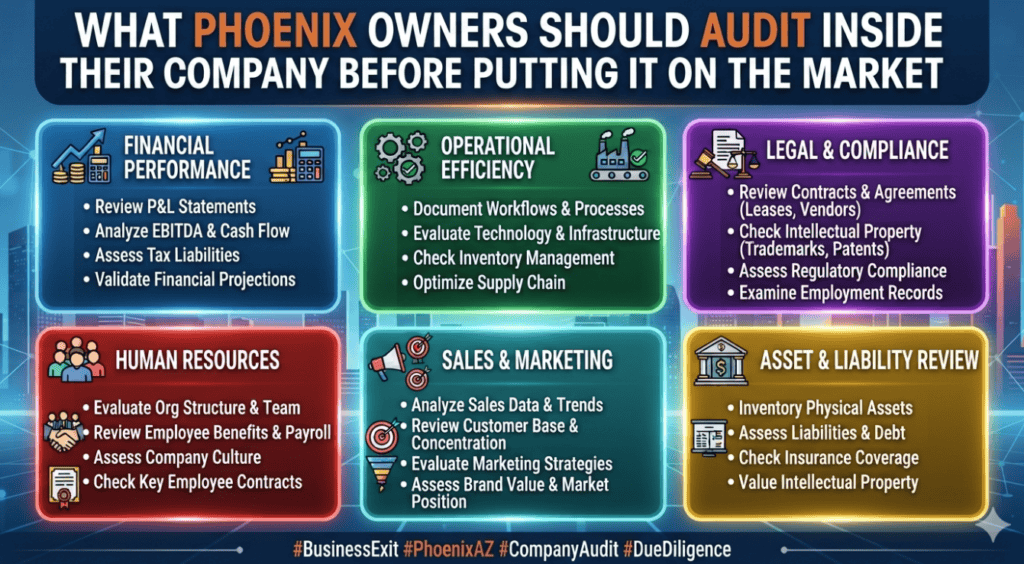
Selling a company in Phoenix is a major financial decision that requires more preparation than simply finding a buyer and agreeing on a price. Before a business goes to market, owners should examine the internal condition of the company from the perspective of a potential buyer. Buyers typically look beyond revenue and profitability because they want to understand how sustainable, transferable, and defensible the business really is. A company with strong financial performance can still face valuation challenges if its records, operations, contracts, customer relationships, or management structure are difficult to verify. Conducting a detailed internal audit gives owners an opportunity to identify weaknesses while there is still time to correct them. At Valued Business Exits, we help business owners approach the sale process with a clearer understanding of what buyers are likely to examine and where preparation can strengthen the overall transaction.
Start With a Financial Health Audit
Financial records are among the first areas a prospective buyer is likely to investigate when evaluating a Phoenix company. Owners should review several years of income statements, balance sheets, cash flow statements, tax returns, bank records, and other financial documentation to make sure the information tells a consistent story. Revenue should be reconciled against accounting records, deposits, invoices, and customer agreements wherever possible. Owners should also identify unusual expenses, personal expenses, one time costs, discretionary spending, and other adjustments that may affect the way normalized earnings are calculated. Any unexplained difference between financial documents can create additional questions during due diligence and potentially weaken buyer confidence. A financial audit before marketing the business allows owners to resolve inconsistencies and present a cleaner financial picture.
Examine Revenue Quality Rather Than Revenue Alone
A high revenue figure does not automatically mean that a business will command a strong market valuation. Buyers are often interested in understanding how dependable that revenue is and whether it can continue after the ownership transition. Phoenix owners should examine recurring revenue, customer retention, contract length, seasonal fluctuations, average transaction values, and the concentration of sales among major customers. A company that relies heavily on a small number of customers may face greater perceived risk than a company with a broader and more diversified customer base. Owners should also determine whether recent revenue growth resulted from sustainable business improvements or temporary circumstances that may not continue. Understanding revenue quality before the business reaches the market allows the owner to address concerns and explain the company’s earnings profile with greater confidence.
Review Customer Concentration
Customer concentration can have a significant influence on how buyers perceive risk during a business acquisition. If one customer represents a substantial portion of annual revenue, a buyer may worry about what would happen if that relationship ended after the acquisition. Owners should identify their largest customers and calculate the percentage of total revenue represented by each relationship. They should also review the history of those accounts, including contract terms, renewal patterns, purchasing behavior, and the length of the relationship. Where possible, businesses should work toward reducing excessive dependence on one or two accounts before beginning a formal sale process. A diversified customer base can demonstrate that the company’s performance is supported by a broader market rather than by a single relationship. This type of preparation can make the business easier for a buyer to understand and potentially reduce concerns during negotiations.
Audit Contracts and Legal Documents
Contracts represent another important area that Phoenix business owners should review before placing their company on the market. Customer agreements, vendor contracts, leases, employment agreements, partnership arrangements, licensing documents, intellectual property agreements, and financing arrangements can all affect the value and transferability of a business. Owners should determine whether important contracts can be transferred to a new owner or whether they require consent from another party. They should also look for automatic renewal clauses, termination provisions, restrictive conditions, change of control provisions, and obligations that could affect a transaction. Missing or outdated agreements can create unnecessary uncertainty when buyers begin their due diligence process. Reviewing the company’s contractual foundation in advance gives owners time to address issues rather than discovering them after negotiations have already started.
Check Business Licenses and Regulatory Compliance
Every company should have a clear understanding of the licenses, permits, registrations, and regulatory obligations associated with its operations. Phoenix businesses may have requirements that vary depending on their industry, physical location, employees, services, and operating model. Owners should confirm that required licenses remain active and that the company has maintained appropriate records demonstrating compliance. Any unresolved regulatory matter, expired permit, outstanding filing, or compliance concern should be identified before marketing begins. Buyers may view regulatory uncertainty as a potential liability, particularly when the issue could interfere with continued operations following a transaction. Completing this review early provides an opportunity to resolve manageable issues and document the company’s compliance position.
Review Employee Structure and Key Personnel
A business can become considerably harder to sell when its success depends almost entirely on the owner or one irreplaceable employee. Phoenix owners should examine the organizational structure and determine who is responsible for sales, operations, customer service, finance, technology, and other essential functions. They should identify which employees possess specialized knowledge and consider whether that knowledge has been properly documented and transferred within the organization. Compensation arrangements, employment agreements, benefits, incentive plans, vacation liabilities, and retention concerns should also be reviewed. A buyer wants to understand whether the company can continue operating effectively after the current owner leaves. Developing a capable management structure and documenting important responsibilities can demonstrate that the business is an operating enterprise rather than a job built around one individual.
Measure How Dependent the Company Is on the Owner
Owner dependency is one of the most important internal issues to evaluate before selling a privately held business. If the owner personally handles most sales, maintains critical customer relationships, approves every major decision, manages employees, and oversees daily operations, a buyer may see substantial transition risk. Owners should document their recurring responsibilities and determine which tasks can be delegated to managers or employees. They should also examine whether customers have relationships with the company itself or primarily with the owner personally. Creating standardized processes and distributing responsibilities can make the organization more transferable. A company that continues to function efficiently without constant owner involvement may be viewed as more stable and easier to acquire.
Audit Operational Processes
Strong operations are often invisible when everything is working correctly, but weak processes become obvious when a buyer starts asking detailed questions. Owners should review how orders are processed, how customers are onboarded, how inventory is managed, how services are delivered, how quality is monitored, and how complaints are handled. Important operational procedures should be documented rather than existing only through informal knowledge held by the owner or a small group of employees. Owners should also identify bottlenecks that could limit growth or create operational disruption following a change in ownership. Standardized procedures can improve consistency while making the company easier for a new operator to understand. Before going to market, owners should be able to explain how the business functions from the first customer interaction through delivery and post sale support.
Evaluate Technology and Digital Infrastructure
Technology has become an important part of business value across many industries, and owners should not overlook digital infrastructure during their pre sale audit. Companies should review their websites, domains, software subscriptions, customer relationship management systems, accounting platforms, cloud storage, cybersecurity controls, email systems, data backups, and other technology assets. Owners should determine who owns each account and whether important digital assets are registered to the company rather than an individual employee. They should also identify outdated systems that could create operational or security risks for a buyer. Digital marketing assets, analytics accounts, social media profiles, online directories, and customer databases may also contribute to the overall value of the company. A clear technology inventory helps establish what exactly is being transferred as part of the transaction.
Investigate Intellectual Property Ownership
Intellectual property can represent significant value, particularly when a company owns a recognizable brand, proprietary technology, original content, processes, designs, software, or other intangible assets. Owners should verify that trademarks, copyrights, domain names, proprietary materials, and other intellectual property are properly owned by the company. They should also review agreements with employees, contractors, agencies, and developers to determine whether intellectual property created for the company was appropriately assigned. An asset that the owner assumes belongs to the company may not necessarily be documented that way legally. Any uncertainty surrounding intellectual property ownership can become a significant due diligence issue. Establishing clear ownership before marketing the business can reduce friction and give buyers greater confidence in the assets included in the transaction.
Review Inventory and Physical Assets
Companies that maintain inventory, equipment, vehicles, machinery, furniture, or specialized tools should conduct a detailed asset review before entering the market. Owners should confirm what assets the company owns, what assets are leased, and what assets may have outstanding financing obligations. Inventory should be reviewed for obsolete products, damaged goods, slow moving items, and discrepancies between physical quantities and accounting records. Equipment should be assessed based on age, condition, maintenance history, and expected replacement requirements. Buyers may question the quality of earnings if the company requires substantial capital expenditures immediately after acquisition. A well organized asset audit provides a clearer picture of what the buyer is actually acquiring and helps prevent disagreements about asset values later in the process.
Analyze Outstanding Debt and Liabilities
Debt and liabilities deserve careful attention before a business is presented to potential buyers. Owners should review loans, lines of credit, equipment financing, accounts payable, tax obligations, leases, deferred expenses, legal claims, and other financial commitments. It is important to understand which obligations will remain with the company and which may need to be settled as part of the transaction. Hidden or poorly documented liabilities can create significant complications during due diligence. Owners should also review whether there are contingent liabilities that may not appear immediately on a standard balance sheet. A comprehensive liability review helps the seller and professional advisors establish a more accurate understanding of the company’s financial position before negotiations begin.
Examine Tax Records Carefully
Tax documentation can provide buyers with an important independent reference point for evaluating a company’s financial performance. Owners should review federal, state, and applicable local tax filings and compare reported information with internal accounting records. Any unpaid balances, unresolved notices, amended returns, audits, or unusual tax positions should be identified early. Owners should also ensure that payroll taxes and other employment related obligations have been properly handled. Differences between tax filings and management financial statements may require explanations during the due diligence process. Resolving or documenting tax related issues before marketing can help prevent avoidable delays once a buyer begins reviewing the company.
Assess Online Reputation and Brand Perception
A company’s reputation can influence both buyer interest and the future sustainability of revenue. Phoenix owners should review online reviews, customer feedback, social media mentions, industry discussions, complaint records, and other public indicators of customer sentiment. Negative reviews do not necessarily make a company unsellable, but unexplained patterns can raise questions about customer retention and operational quality. Owners should examine whether complaints relate to isolated incidents or recurring business problems. They should also ensure that positive reputation assets are properly documented and maintained. A strong and credible brand reputation can become an important supporting factor when buyers evaluate the durability of customer relationships.
Identify Hidden Operational Risks
Every company has risks, but owners should understand them before a buyer discovers them independently. Risks may include dependence on a specific supplier, aging equipment, employee turnover, cybersecurity weaknesses, customer concentration, regulatory exposure, seasonal revenue, or outdated technology. Owners should create an internal picture of the factors that could disrupt revenue or increase expenses after the acquisition. The purpose of this exercise is not to make the company appear perfect because experienced buyers understand that every business has risks. Instead, the objective is to demonstrate that management understands those risks and has reasonable systems in place to control them. A business with documented risk management practices can appear more mature and predictable during the acquisition process.
Review Growth Opportunities From a Buyer’s Perspective
Owners should not only audit current weaknesses but also examine opportunities that a new owner could realistically pursue. Buyers are often interested in businesses where additional growth can be achieved through geographic expansion, new services, improved marketing, additional sales staff, technology investments, or operational improvements. Phoenix offers a diverse business environment, so the potential for expansion can vary significantly depending on the company’s industry and target market. Owners should identify opportunities that are supported by actual data rather than presenting speculative claims. Historical customer inquiries, unused capacity, geographic demand, conversion rates, and underdeveloped service lines can provide useful evidence. Clearly identifying credible growth opportunities can help buyers understand the upside of acquiring the company.
Organize a Due Diligence File Before Marketing
Once the internal audit is complete, owners should organize the supporting documentation into a structured due diligence file. Financial statements, tax returns, contracts, employee information, licenses, asset records, intellectual property documents, insurance policies, customer information, supplier agreements, and operational materials should be organized so that they can be accessed efficiently when requested. A disorganized document collection can slow down the transaction and create unnecessary questions. Owners should also establish a consistent naming and filing system so that important records can be located quickly. Sensitive information should only be shared with appropriate parties under suitable confidentiality protections. Preparing this material before buyer outreach can make the transaction process more controlled and professional.
Use the Audit to Improve the Business Before the Sale
A pre sale audit should not simply identify problems because it can also reveal opportunities to improve the company before it is presented to buyers. If financial records are inconsistent, owners can clean up the accounting system. If operations depend too heavily on the owner, responsibilities can be delegated and documented. If customer concentration is excessive, the company may have an opportunity to diversify its sales pipeline before entering negotiations. If technology systems are outdated, targeted improvements may increase efficiency and reduce buyer concerns. Not every problem needs to be completely eliminated before a business is sold, but meaningful improvements can strengthen the overall story behind the company. The goal is to enter the market with a business that is organized, defensible, transferable, and easier for a buyer to evaluate.
Why Preparation Can Influence the Final Outcome
The condition of a business before it reaches the market can influence buyer interest, negotiation leverage, transaction speed, and ultimately the terms of a sale. Buyers are more likely to investigate deeply when they encounter inconsistencies, unclear documentation, owner dependency, or unexplained risks. Conversely, organized financial records, documented processes, diversified customers, transferable contracts, and reliable management systems can create a stronger foundation for discussions.
Preparation also gives owners greater control because they can address issues on their own timeline rather than responding to problems after a buyer has identified them. A thorough internal audit can therefore become part of the broader strategy for maximizing business value. At Valued Business Exits, our approach is centered on helping owners understand the factors that can influence marketability and preparing the business for a more informed exit process.
Take a Buyer’s View Before You Go to Market
The most useful question a Phoenix business owner can ask before selling is whether an outside buyer would immediately understand why the company is valuable. The answer should be supported by financial evidence, operational documentation, customer stability, transferable assets, qualified personnel, and realistic growth opportunities. Owners should examine the company as objectively as possible instead of relying only on years of personal experience with the business. Any weakness that can be identified and addressed before buyer outreach may become one less issue to negotiate later. The strongest preparation is not about making a business look perfect but about making its strengths easy to verify and its risks easier to understand. By conducting a disciplined internal audit before going to market, owners can enter the sale process with greater clarity and a stronger foundation for evaluating offers.