

How Customer Concentration Affects Business Value in Phoenix
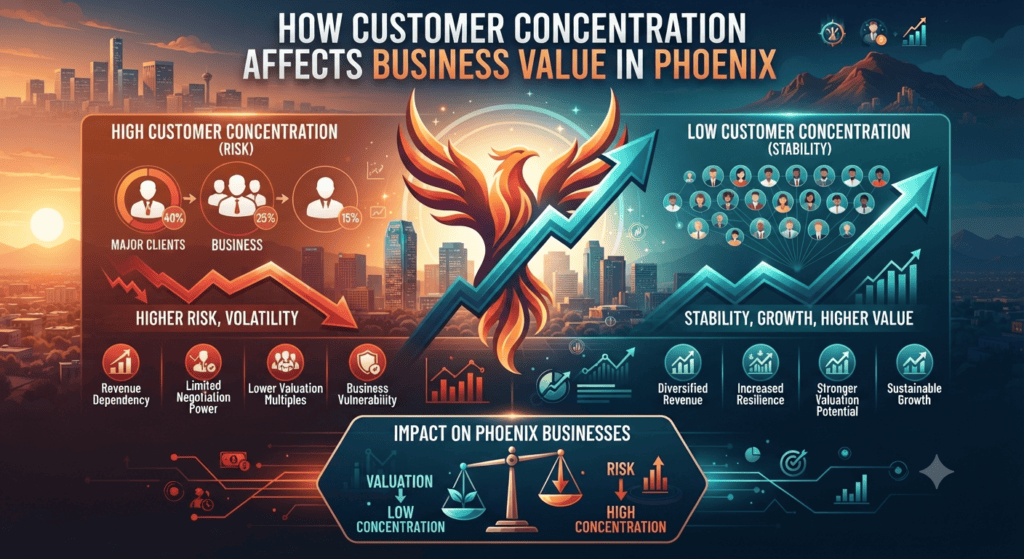
How Customer Concentration Affects Business Value in Phoenix
Business owners often focus on growing revenue, improving profitability, and expanding operations when preparing for a future sale. While these goals are essential, one factor that frequently has an even greater impact on valuation is customer concentration. A company that depends too heavily on a small number of customers may appear financially successful, yet still receive a lower valuation than expected. Buyers carefully evaluate customer diversity because it directly influences the stability and future growth of the business.
For business owners in Phoenix, understanding how customer concentration affects value can make the difference between an average exit and an exceptional one. As industries across the region continue to expand, investors and buyers are looking for businesses with reliable, diversified income streams that reduce risk and create long term opportunities.
What Is Customer Concentration?
Customer concentration refers to the percentage of a company’s revenue that comes from its largest customers. For example, if one customer accounts for 40 percent of annual sales, the business has a significant level of customer concentration. If the top five customers generate 80 percent of total revenue, the company also carries a high concentration risk.
While securing major clients is a positive achievement, depending too heavily on them can create uncertainty for future owners. Buyers recognize that losing even one key customer after acquisition could have a dramatic impact on profitability.
Why Buyers Pay Close Attention
When buyers evaluate a business, they are purchasing future earnings rather than past performance alone. A company with stable, diversified revenue appears more predictable and less risky.
High customer concentration raises several concerns.
The largest customer may decide to switch suppliers after the ownership transition.
Contract renewals may not be guaranteed.
Large customers often have stronger negotiating power, reducing profit margins.
Revenue can decline rapidly if one major relationship ends.
Operational planning becomes more difficult when income depends on only a few accounts.
Because of these risks, buyers frequently adjust their valuation models or require additional protections before completing the acquisition.
How Customer Concentration Impacts Valuation Multiples
Business valuations are commonly based on earnings multiples. Companies with diversified customer bases generally receive higher multiples because buyers view their future cash flow as more secure.
A business earning one million dollars annually with hundreds of active customers may receive a significantly higher valuation multiple than another company earning the same amount from only three customers.
The difference has little to do with current profits. Instead, it reflects the level of risk associated with maintaining those earnings after ownership changes.
Even if your largest customer has been loyal for many years, buyers cannot assume that relationship will continue indefinitely.
Customer Concentration in the Phoenix Market
Phoenix has experienced rapid economic growth across industries including healthcare, manufacturing, logistics, construction, technology, and professional services. Many businesses have benefited by securing contracts with major regional employers or government agencies.
Although landing these large accounts can accelerate growth, relying too heavily on one organization creates exposure that buyers immediately recognize during due diligence.
For example, a supplier serving primarily one manufacturing company may generate impressive revenue today. However, if that customer relocates operations, reduces production, or changes vendors, the business could lose a substantial portion of its income almost overnight.
Businesses serving a broad mix of industries, customer sizes, and market segments generally present stronger investment opportunities.
The Importance of Customer Contracts
Well documented contracts can reduce some of the concerns associated with customer concentration.
Long term agreements with automatic renewals provide buyers with greater confidence than verbal arrangements or informal purchasing relationships.
Contracts should clearly define service expectations, pricing structures, renewal terms, and termination conditions.
Businesses that can demonstrate stable contractual relationships often experience smoother transactions, even if customer concentration remains moderately high.
Industry Matters
Not every industry experiences customer concentration in the same way.
Business to business companies often have fewer, larger customers compared to retail businesses with thousands of individual clients. Buyers understand these industry differences but still evaluate whether concentration levels exceed what is considered normal.
For example, a specialized engineering firm may naturally serve fewer clients than an online retailer. However, even within specialized industries, excessive reliance on one account increases perceived risk.
Understanding industry benchmarks helps position your business appropriately during the sale process.
Diversification Improves Buyer Confidence
One of the most effective ways to increase business value is by expanding the customer base before beginning the sale process.
This does not necessarily require adding hundreds of new customers. Instead, the objective is reducing dependence on any single revenue source.
Business owners can strengthen diversification by expanding into new industries, targeting additional geographic markets, developing new products or services, increasing recurring revenue programs, attracting smaller customers alongside larger accounts, and strengthening customer retention across the entire client portfolio.
As revenue becomes more balanced, buyers gain confidence that future earnings will remain stable regardless of changes involving individual customers.
Due Diligence Will Reveal Customer Risks
Every serious buyer conducts extensive due diligence before finalizing an acquisition.
During this process they typically examine customer lists, revenue by customer, historical purchasing patterns, contract terms, renewal schedules, customer retention rates, sales trends, and account profitability.
If concentration issues appear unexpectedly during due diligence, negotiations may become more difficult. Buyers may reduce their offer, request seller financing, negotiate earn out agreements, or seek additional guarantees.
Preparing these records in advance allows sellers to address concerns proactively rather than reacting during negotiations.
Strategies to Reduce Customer Concentration Before Selling
Business owners planning an exit within the next few years should begin reducing customer concentration as early as possible.
Investing in sales and marketing can attract new clients and balance existing revenue streams. Developing additional service offerings can create opportunities within different customer segments. Improving customer retention across the entire portfolio also strengthens recurring revenue.
Cross selling existing services to a wider customer base helps distribute income more evenly while creating stronger long term relationships.
Even modest improvements in diversification can positively influence buyer perception and valuation.
Customer Relationships Still Matter
While diversification is important, maintaining strong relationships with existing customers remains equally valuable.
Businesses with long standing customers, high satisfaction scores, excellent service records, and consistent communication demonstrate operational strength.
Buyers appreciate businesses that have earned customer loyalty through quality service rather than dependence created by limited competition.
The goal is not replacing major customers but reducing the overall financial impact if one customer eventually leaves.
Professional Preparation Makes a Difference
Many business owners underestimate how much preparation influences final sale value. Customer concentration is only one of many factors buyers evaluate, but it is among the most influential.
Working with experienced advisors before taking a business to market allows owners to identify valuation risks early, improve financial positioning, organize documentation, and present the company in the strongest possible manner.
Small operational improvements made years before a sale often generate substantial returns during negotiations.
Planning for a Stronger Exit
Every business has strengths and weaknesses. High customer concentration does not automatically prevent a successful sale, but it does require thoughtful planning. Buyers want confidence that revenue will remain stable after ownership changes, and a diversified customer base helps provide that assurance.
Whether you expect to sell next year or several years from now, evaluating your customer portfolio today can create opportunities to improve valuation and strengthen your negotiating position.
At Valued Business Exits, we work with business owners throughout Phoenix to identify value drivers, reduce potential buyer concerns, and prepare businesses for successful transitions. Our experience helps owners understand how factors like customer concentration influence valuation while developing practical strategies that support stronger outcomes.
Selling a business represents years of hard work, dedication, and investment. By addressing customer concentration before entering the market, you position your company for greater buyer confidence, stronger offers, and a smoother transaction. Valued Business Exits believes preparation is one of the most effective ways to maximize business value. When owners understand the factors buyers prioritize, they are better equipped to achieve the successful exit they have worked so hard to build.
