

Why Some Phoenix Companies Sell Faster Than Others Even When Their Financials Look Similar
Why Some Phoenix Companies Sell Faster Than Others Even When Their Financials Look Similar
Financial Similarity Does Not Mean Sale Readiness
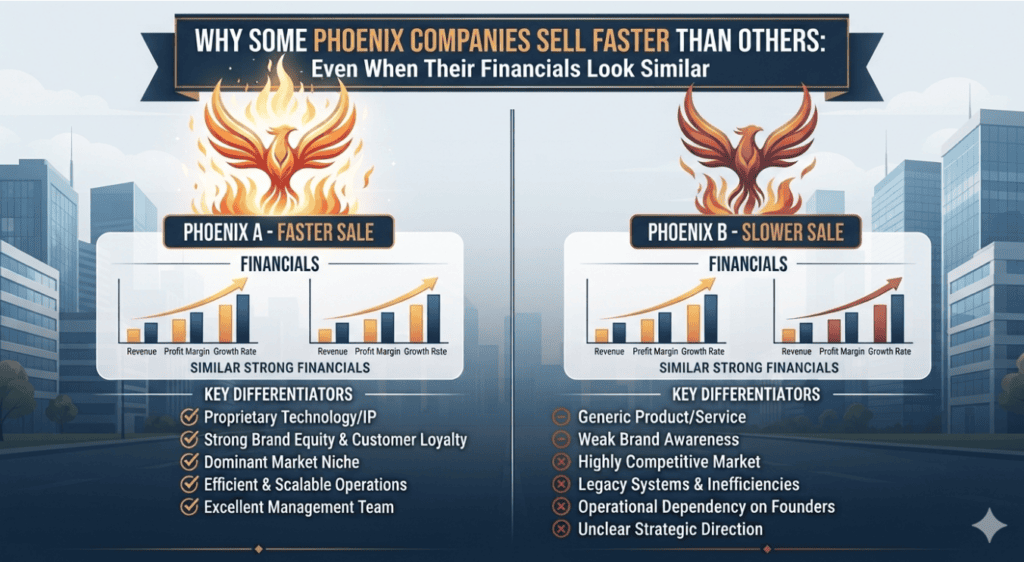
Two Phoenix companies can report similar revenue, comparable profit margins, and nearly identical cash flow while experiencing completely different outcomes when they enter the business sale process. One may attract qualified buyers within weeks, while the other can remain on the market for months with little meaningful interest. At first glance, the difference can seem difficult to explain because financial statements are often the first information buyers review. However, experienced buyers evaluate far more than historical financial performance before deciding whether to pursue an acquisition. They also examine operational stability, owner dependence, customer relationships, market position, documentation, growth opportunities, and potential risks. This is why financial similarity does not automatically translate into similar buyer demand or transaction speed.
Buyer Confidence Can Change the Entire Timeline
The speed of a business sale is strongly influenced by how quickly a buyer can become confident in the opportunity. Buyers are committing significant capital, so they want evidence that the business can continue producing reliable results after ownership changes. A company with organized records, documented procedures, stable employees, and predictable customer relationships can create confidence much faster than a company that depends heavily on informal processes. Even when both companies produce the same annual earnings, the perceived risk can be dramatically different. A buyer may therefore move quickly on one opportunity while requesting extensive additional information from another. We focus on helping owners understand that creating buyer confidence is just as important as presenting attractive financial results.
Owner Dependence Can Slow Down a Sale
One of the biggest differences between otherwise similar companies is how dependent the business is on its owner. If the owner personally handles sales, manages important accounts, approves major decisions, oversees employees, and maintains critical relationships, buyers may worry about what happens after the transaction. A business that operates effectively without constant owner involvement is usually easier for a buyer to understand and transition into. This does not mean owners need to completely remove themselves from daily operations before selling. Instead, buyers generally want to see that responsibilities can be transferred through established systems and capable employees. When the company itself appears stronger than the individual owner dependency surrounding it, the acquisition can become easier to evaluate and execute.
Documented Systems Make Businesses Easier to Understand
A buyer cannot always see the value of a business simply by looking at its income statement. They need to understand how the company actually generates revenue and maintains its operations. Written procedures, employee responsibilities, vendor information, sales processes, customer management systems, and operational workflows can make this much easier. When important knowledge exists only in the owner’s head, the buyer may perceive additional transition risk. Documentation allows the buyer to see that the business has repeatable processes rather than relying on individual memory or personal relationships. Companies with similar financial results can therefore have very different levels of perceived value depending on how clearly their operations are documented.
Customer Concentration Can Affect Buyer Interest
Revenue quality is another factor that can separate two financially similar companies. Consider two businesses that each generate several million dollars in annual revenue, but one receives that revenue from hundreds of customers while the other relies heavily on a few major accounts. The second company may appear more vulnerable because losing one significant customer could materially reduce future earnings. Buyers typically want to understand customer concentration, contract duration, renewal patterns, retention rates, and the strength of customer relationships. A diversified customer base can provide greater confidence that revenue will remain stable following an acquisition. This can make a company more attractive even when its current financial statements are almost identical to those of a competitor.
Recurring Revenue Can Accelerate Buyer Decisions
The predictability of future revenue can be more compelling than a strong historical revenue figure by itself. Companies with recurring contracts, subscription arrangements, maintenance agreements, repeat purchasing patterns, or other dependable revenue sources can provide buyers with greater visibility into future performance. A business that produces substantial revenue through unpredictable one-time transactions may require more detailed analysis. Buyers may need to investigate sales pipelines, historical seasonality, customer acquisition patterns, and the likelihood of repeat business. Meanwhile, a company with highly predictable revenue can often communicate its future earnings potential more clearly. This distinction can significantly influence how quickly a buyer progresses from initial interest to serious negotiations.
Employee Stability Reduces Transition Risk
Employees can represent a major component of a company’s value, particularly when specialized knowledge or customer relationships are involved. A buyer wants to know whether key employees are likely to remain after the transaction and whether the workforce can continue operating effectively under new ownership. High employee turnover can raise questions about workplace stability, management quality, compensation structures, and operational continuity. In contrast, a stable team with clear responsibilities can make the transition appear much less complicated. Businesses with similar profits can therefore receive different levels of buyer interest based on the strength and stability of their workforce. Preparing information about key employees, roles, tenure, and responsibilities can help owners demonstrate that the company has an operational foundation beyond the owner.
A Strong Management Structure Can Improve Marketability
Management depth is closely related to employee stability, but it deserves separate consideration. A business that has experienced managers capable of overseeing important functions can often appear more scalable and transferable. Buyers are usually interested in understanding who will keep operations running when the current owner is no longer involved. If there are capable people already responsible for finance, sales, operations, customer service, or production, the transition can become considerably easier. A company without management depth may require the buyer to become deeply involved immediately after closing. That additional responsibility can discourage some buyers or lead them to negotiate more aggressively on price.
Clean Financial Records Build Trust
Financial statements may look similar at a high level, but the underlying quality of the records can be very different. Buyers and their advisors may examine bank statements, tax returns, general ledgers, expense classifications, payroll records, accounts receivable, accounts payable, and other supporting documentation. Inconsistent classifications, unexplained expenses, missing documentation, or discrepancies between financial reports and tax filings can create unnecessary questions. Every unresolved question can add time to the due diligence process. Clean and consistent financial records allow buyers to validate earnings more efficiently and reduce uncertainty. When owners prepare these materials before going to market, they can prevent avoidable delays that have nothing to do with the underlying strength of the business.
Adjusted Earnings Need to Be Easy to Verify
Many privately owned companies contain legitimate expenses that may not continue after a transaction. Personal expenses, owner-specific costs, unusual one-time expenditures, and other adjustments can sometimes be normalized when determining the company’s true earnings potential. However, buyers need to understand and verify these adjustments before accepting them. If an owner presents a large number of adjustments without clear supporting documentation, the buyer may become skeptical about the quality of reported earnings. A smaller number of well-supported adjustments can often be more persuasive than an aggressive attempt to maximize adjusted earnings. Clear explanations and supporting records help buyers distinguish genuine normalized expenses from assumptions that may not withstand due diligence.
Growth Opportunities Can Make One Company More Attractive
Two Phoenix companies with similar current financial performance may have very different future potential. One business might operate in a market with substantial room for geographic expansion, additional services, new customer segments, or improved marketing. Another might already be operating close to its practical capacity with limited opportunities for expansion. Buyers frequently consider what they can accomplish with the business after acquisition, not simply what the company has accomplished historically. A clear and credible growth opportunity can make an otherwise similar business more compelling. Owners who can demonstrate realistic opportunities supported by data can give buyers a stronger reason to prioritize their company.
Market Position Matters Beyond Revenue
Revenue does not fully explain how strong a company’s competitive position may be. A business with a recognizable local reputation, specialized expertise, strong customer loyalty, proprietary processes, or established relationships may possess valuable advantages that are not immediately visible in financial statements. Phoenix is a competitive market with businesses operating across a wide range of industries, so buyers may compare several opportunities before choosing one. A company that can clearly explain what makes it difficult to replace can stand out during this comparison. Buyers want to understand why customers choose the company and whether those reasons are likely to remain intact after an ownership transition. Strong market positioning can therefore shorten the time required to move a qualified buyer from interest to serious discussions.
Reputation Can Influence Buyer Perception
A company’s reputation can affect both customer retention and buyer confidence. Negative online reviews, unresolved customer complaints, legal disputes, employee disputes, or inconsistent public messaging can introduce concerns that financial statements will not reveal. Buyers may investigate online reviews, industry feedback, customer relationships, and other public information during their evaluation. A company with a clean and credible reputation can present a much lower perceived risk. This becomes particularly important when buyers are comparing multiple companies that appear similar financially. Preparing for a sale therefore involves managing the broader perception of the company, not simply preparing accounting documents.
Legal and Operational Issues Can Create Delays
Even a profitable business can experience a slower transaction if important legal or operational matters remain unresolved. Buyers may examine leases, licenses, permits, contracts, intellectual property, insurance coverage, employment arrangements, supplier agreements, and other obligations. Missing documents can lead to repeated requests during due diligence and create uncertainty around the transaction. Issues that could have been resolved before marketing the business may become negotiating points once a buyer discovers them. Owners who identify these matters early have more time to address them strategically. This can make the transaction process more predictable and reduce surprises that could otherwise slow negotiations.
Transferability Is One of the Most Important Factors
A buyer is not simply purchasing past performance. They are purchasing the expectation that the business can continue generating economic value under new ownership. Transferability therefore becomes a central question during the sale process. Customers, employees, suppliers, leases, licenses, technology, contracts, and operational systems may all need to transition successfully. If important components of the business cannot easily transfer, the buyer may consider the opportunity riskier than its financial results suggest. A company with strong transferability can often move through evaluation more efficiently because the buyer can more clearly envision operating it after closing.
The Quality of the Sale Preparation Matters
Some owners begin searching for buyers as soon as they decide they want to sell, without spending enough time preparing the company for scrutiny. This can result in incomplete financial information, unclear operations, unresolved risks, and weak explanations of the company’s value. Other owners approach the process as a preparation project months before the business is formally marketed. They identify weaknesses, organize documentation, strengthen management structures, clarify financial performance, and address avoidable concerns. These companies can enter the market with a much stronger presentation. The difference in preparation can explain why one company receives serious interest quickly while another struggles despite having comparable earnings.
Pricing Strategy Can Affect Speed
A business can also sell slowly simply because its asking price does not align with buyer expectations. Owners naturally want to maximize the proceeds from a transaction, but an unrealistic valuation can reduce the number of qualified buyers willing to engage. Pricing should consider earnings, industry conditions, growth prospects, transferable assets, customer concentration, risk, market demand, and comparable transactions where appropriate. A well-supported asking price gives buyers a clearer basis for evaluating the opportunity. It can also reduce unnecessary negotiation later in the process. The goal should not simply be to establish the highest possible price, but to establish a price that reflects the company’s actual market position and encourages credible buyers to act.
Speed Should Not Come at the Expense of Value
Selling quickly is not necessarily the same as achieving a successful transaction. An owner may receive an offer rapidly but discover that the buyer is demanding extensive protections, significant financing contingencies, or substantial price reductions. Another company may take slightly longer to attract the right buyer but ultimately complete a stronger transaction with better terms. The objective should be to create enough buyer confidence that qualified prospects can move efficiently without sacrificing appropriate valuation. Strong preparation helps balance these two goals. A faster process is most valuable when it also produces a transaction structure that protects the owner’s interests.
Phoenix Buyers Look Beyond the Numbers
The Phoenix business market includes companies with different customer bases, industries, operating models, competitive environments, and growth profiles. Buyers evaluating opportunities in the area may compare businesses based on far more than annual revenue and seller discretionary earnings. They can examine the durability of customer relationships, local competition, workforce stability, management depth, recurring revenue, operational systems, and future growth potential. This means an owner should avoid assuming that financial performance alone determines how attractive a company will be. The strongest sale candidates make their value understandable from multiple perspectives. When the business story is clear, the buyer has fewer reasons to hesitate.
Preparing the Business Before Going to Market
Owners who want to improve their chances of a faster transaction should begin preparation well before contacting prospective buyers. The process can involve reviewing financial records, identifying owner-dependent responsibilities, documenting operational procedures, evaluating customer concentration, organizing contracts, reviewing employee structures, and addressing outstanding risks. It can also involve determining which elements of the company represent its most defensible competitive advantages. The purpose is not to make the business look artificially perfect. The purpose is to present an accurate, organized, and compelling picture of an opportunity that a qualified buyer can understand and evaluate efficiently. We help business owners approach this process strategically so that preparation supports both buyer confidence and transaction objectives.
The Difference Is Often Perceived Risk
Ultimately, two companies can have remarkably similar financial statements while carrying very different levels of perceived risk. Buyers are evaluating whether the earnings they see today are likely to continue after the transaction closes. They are also considering how difficult the business will be to operate, how dependent it is on the owner, how stable its customers and employees are, and whether the company’s advantages can be maintained. A business that answers these questions clearly can move through the sale process much more efficiently. A business that leaves these questions unanswered may face repeated requests, prolonged negotiations, or reduced buyer interest. This is why sale preparation should focus on the entire business rather than financial performance alone.
Building a Business That Buyers Can Say Yes To
The companies that sell faster are not always the companies with the highest revenue or profit. They are often the companies where buyers can quickly understand the opportunity, verify the financial performance, recognize the growth potential, and feel confident about the transition. Strong systems, reliable employees, diversified customers, clean records, transferable operations, and realistic pricing can collectively make a major difference. These characteristics reduce uncertainty and allow serious buyers to make decisions with greater confidence. If your Phoenix company has strong financials but is not generating the buyer interest you expected, the issue may lie outside the income statement. Valued Business Exits works with owners to identify the factors that can influence buyer perception and prepare the business for a more efficient and strategically managed sale.